GRAHAN IN JYOTISH SHASTRA
INRODUCTION TO GRAHAN
Grahan, commonly known as an eclipse, holds a deeply significant place in Hindu philosophy, scriptures as well as in Vedic Astrology. Jyotish Shastra interprets Grahan as a powerful karmic and spiritual event that influences human consciousness, collective energy and individual horoscopes, unlike modern astronomy, which views eclipses purely as celestial alignments. To truly understand Grahan, one must explore the astrological meaning, mythological roots, planetary controllers and its perceived inauspiciousness.
WHAT IS GRAHAN IN VEDIC ASTROLOGY?
In Jyotish, the term 'Grahan' literally means to seize, grasp or obscure. Astrologically, it refers to a phenomenon where the light of a luminary—Surya (Sun) or Chandra (Moon) is temporarily obstructed, symbolizing a disturbance in cosmic order.
Thus, Grahan is seen as a temporary imbalance in the flow of pranic and cosmic energy, affecting both nature and human life. Since Sun represents soul, authority, vitality and Moon signifies the mind, emotions and mental stability, their obscuration is believed to have profound psychological and karmic effects.
MYTHOLOGICAL ORIGIN OF GRAHAN
According to the Samudra Manthan legend in Hindu beliefs, the demon Swarbhanu disguised himself as a Deva and consumed Amrit, i.e. nectar of immortality. Vishnu beheaded him with the Sudarshan Chakra, but since the nectar had already entered his system, his head and body became immortal.
The severed head became Rahu and the headless body became Ketu. Out of vengeance, Rahu and Ketu eternally chase Sun and Moon, periodically swallowing them, and creating barriers, resulting in eclipses.
In Jyotish, while Rahu represents obsession, illusion, material desire and worldly entanglement, Ketu denotes detachment, moksha, past-life karma and spiritual insight. Grahan occurs when Rahu or Ketu conjuncts the Sun or Moon or when they aspect these luminaries powerfully. Thus, a Grahan is not just an astronomical event but a karmic activation point, triggering unresolved past-life patterns.
TWO TYPES OF GRAHAN
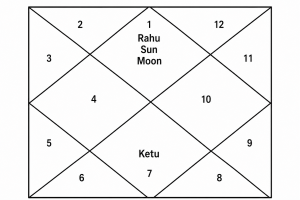
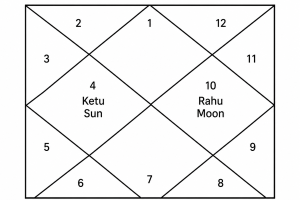
Vedic astrology recognizes two primary types of Grahan - Surya Grahan or Solar Eclipse and Chandra Grahan or Lunar Eclipse. And Rahu & Ketu, known as ‘chhaya graha’ or shadow planets, are the main controllers of Grahan.
ASTRONOMICAL BASIS OF GRAHAN
From an astronomical perspective, Surya Grahan occurs when Moon comes between the Earth and Sun, while Chandra Grahan happens when Earth comes between the Sun and Moon.
But Grahan in Vedic Astrology is far more than an astronomical eclipse. Vedic astrology accepts this physical alignment but adds a symbolic and karmic layer, attributing eclipses to the shadow planets Rahu and Ketu, which do not have physical bodies but possess immense astrological power.
So, whether it is Surya Grahan impacting the soul or Chandra Grahan influencing the mind, the involvement of Rahu and Ketu transforms eclipses into powerful astrological events. This happening is a cosmic reminder of impermanence, karmic balance and inner awareness.
ROLE OF RAHU AND KETU IN GRAHAN
In Vedic astrology, Rahu and Ketu are considered to play the most predominant role in occurrence of Grahan. These planets, also known as north and south lunar nodes represent the points where Moon's orbit intersects the ecliptic, i.e. the Sun's apparent path.
Eclipses occur when the Sun and Moon align closely with these nodes, symbolically swallowed by Rahu or guarded by Ketu according to ancient mythology and texts. This alignment obscures the luminaries - Sun and Moon, temporarily diminishing their positive light and energy, which is why eclipses are generally considered inauspicious.
WHY GRAHAN IS CONSIDERED INAUSPICIOUS?
The primary reason for inauspiciousness of grahan lies in the disturbance of cosmic order. The obscuration of Sun or Moon symbolizes a temporary breakdown of harmony. In addition, Rahu & Ketu, malefic by nature, amplifies negative energies, intensifying illusion and confusion. All these lead to mental and emotional instability, especially during Chandra grahan, when the mind becomes vulnerable since moon controls the mind.
Traditional Indian scriptural texts too consistently describe Grahan as inauspicious or 'ashubha', not due to fear, but because of its energetic and psychological implications. Hindu spiritual books like Skanda Purana, Garuda Purana, Smritis and Dharma Shastras advise avoiding auspicious activities during Grahan, as also refraining from eating, cooking or initiating new ventures.
However, even if Grahan is considered highly inauspicious for material acts, it is recognized immensely potent for spiritual practices such as mantra japa, charity or daan and meditation. Thus, Grahan is not bad in absolute terms - it is a time of caution, introspection and karmic cleansing.
That apart, grahan allows us to appreciate the ancient wisdom that views the universe as deeply interconnected with human life. In essence, Grahan is not to be feared—but to be understood, respected and utilized for inner growth.
SURYA GRAHAN IN HOROSCOPE
Surya Grahan occurs on a New Moon (Amavasya) day when the Sun and Moon are conjunct in the same sign, degree or very close, and Rahu or Ketu also joins them in a horoscope.
Sun & Moon conjunct Rahu, or very close to Rahu/Ketu axis during New Moon is most commonly associated with swallowing the sun and moon. But, without Rahu/Ketu alignment in the same sign, or very close conjunction, no eclipse occurs, even on Amavasya.
This conjunction must happen very near Rahu or Ketu - typically within a small orb, often ~9–18° depending on the type of eclipse and sources, with tighter conjunctions producing total eclipses.
Surya Grahan is considered more intense and transformative, often bringing changes related to power structures, rulers, institutions and ego-related matters. Moreover, solar eclipse has long-term karmic implications and affects soul, self-confidence, authority, leadership, government and father because Sun is the king, which loses much of its strength.
CHANDRA GRAHAN IN HOROSCOPE
On the other hand, lunar eclipse or Chandra Grahan occurs on Purnima or full Moon day, when the Sun and Moon are opposite approximately 180° apart, in opposite signs in a horoscope. The Sun, Earth and Moon align, with Earth between Sun and Moon. Again, this opposition must align closely with the Rahu-Ketu axis with Moon near one node, Sun near the opposite node.
In Jyotish, Moon conjunct or very close to Rahu or Ketu during Full Moon, Ketu is often linked to lunar eclipses in some traditions, though both nodes can cause either type depending on position. The closer the luminaries are to the nodes, the more complete the eclipse.
Chandra Grahan is known for causing emotional turbulence, anxiety, confusion and heightened sensitivity as moon governs mind and thus affects mind, emotions, mental peace, mood and mother. The impact is often immediate but relatively short-lived till the graham lasts.
GRAHAN DOSHA
In a natal horoscope, if someone is born during an eclipse, i.e. Sun or Moon tightly conjunct with Rahu or Ketu, it forms Grahan Dosha or eclipse affliction, which can indicate karmic challenges, emotional instability or specific life themes - but remedies exist.
WHY GRAHAN MATTERS TO HUMAN LIFE?
A Grahan is believed to influence the subtle energies affecting human life and consciousness, creating periods of intensified karmic activity and emotional sensitivity. Thus, many astrologers consider a Grahan to be a period when hidden issues surface, long-pending situations reach a turning point, and important transformations begin. Its effects are thought to be stronger for individuals whose birth charts are closely connected to the eclipse degree or zodiac sign.
So,whether viewed from a spiritual or astrological perspective, a Grahan is considered an opportunity to let go of negativity, gain inner clarity, and prepare for positive change in life.
VEDIC ASTROLOGY COURSE
- Learn From The Passionate Researchers on Astrology
- Get Our Researched Findings On A Platter
- We Share Every Bit Of Our Knowledge
JYOTISH STUDY CONTENT
- Systems Approach Based Study
- Easy Learning With Analogies
- Just 12 Classes Over Skype
ASTROLOGY COURSE FEES
- Price – 200 US$ or 14,000 INR